
A Clash of Kings
Basic facts
A Clash of Kings is the second novel in George R. R. Martin’s epic fantasy series A Song of Ice and Fire. Written in English, it was first published in the United Kingdom on November 16, 1998, and in the United States on February 2, 1999, by Voyager Books and Bantam Books respectively. It follows A Game of Thrones and precedes A Storm of Swords. The novel belongs to high fantasy, but its methods also resemble historical fiction and political drama: dynastic claims, military logistics, marriage alliances, divided loyalties, and the suffering of civilians receive as much attention as castles, prophecy, and ancient supernatural forces.
Plot outline
The death of King Robert leaves Westeros without a stable center. The struggle for the Iron Throne becomes an open civil war as several rulers assert competing claims. Robb Stark is proclaimed King in the North and wages war against the Lannisters. Stannis Baratheon and Renly Baratheon each present themselves as the rightful successor, while Balon Greyjoy takes advantage of the disorder to launch an assault from the Iron Islands. In King’s Landing, the Lannisters try to preserve their hold on the capital while managing rival nobles, public unrest, and the danger posed by Stannis’s advancing forces.
The narrative moves among numerous point-of-view characters and locations. Tyrion Lannister arrives in King’s Landing to serve as acting Hand and attempts to defend the city through a mixture of political maneuvering, intelligence gathering, and ruthless practical decisions. Sansa Stark remains trapped inside the royal court, learning how ceremony and courtesy can conceal coercion. Arya Stark travels through a war-torn landscape in disguise, where survival depends on alertness rather than rank. In the North, Bran Stark tries to govern Winterfell while the war disrupts the protection of his home. Jon Snow joins the Night’s Watch beyond the Wall, where the dangers of the far North suggest that the dynastic conflict may be only a human prelude to something older and more threatening.
Across the Narrow Sea, Daenerys Targaryen struggles to keep herself and her followers alive while carrying three newly hatched dragons. Her chapters widen the scope of the story beyond Westeros and show how exile, memory, and the promise of restoration can become sources of political power. Meanwhile, Robb’s victories do not remove the fragility of his position, and attacks on the North expose the limits of military success when a family must defend an enormous and divided realm.
The novel’s major military climax is the Battle of the Blackwater, in which King’s Landing faces a naval assault and a desperate defense. Ships, walls, wildfire, the river, and shifting alliances turn the battle into a test of both strategy and political legitimacy. Its outcome changes the balance of power, but it does not resolve the deeper crisis. By the end, loyalties have been rearranged, families have been fractured, and the war has made clear that the contest for a crown is inseparable from hunger, displacement, terror, and betrayal.
Themes and technique
Power is the novel’s central concern. A crown is not treated as a naturally sacred prize; it depends on bloodline, law, military strength, food, money, alliances, and the ability to persuade others that a claim is legitimate. The novel repeatedly separates the right to rule from the capacity to rule and from the willingness to use violence. Family honor and inherited duty can inspire courage, but they can also become instruments that trap individuals inside political expectations.
Martin’s treatment of war is notably unsentimental. Lords discuss maps, marriages, and troop movements, while ordinary people experience burned settlements, shortages, sexual violence, forced movement, and fear. Battles do not simply provide heroic tests. They transform communities and damage the moral judgment of those who fight. The characters are therefore difficult to classify as wholly good or evil. Compassion, loyalty, vanity, fear, and self-preservation coexist within the same person, often producing consequences that no one fully controls.
The rotating point-of-view structure is crucial to this effect. No single character possesses the complete truth, and the same event can look honorable from one perspective and threatening from another. The red comet functions as both an omen and a projection screen for human anxiety: different people interpret it according to their hopes, religions, and political needs. Alongside the immediate struggle for the throne, the novel develops questions about identity, gender, marriage, faith, family, exile, and the return of forces that the political classes have ignored.
Background and lasting influence
Martin began returning to long-form fiction in 1991 after earlier work in short science fiction, horror, and fantasy and after a substantial period as a television writer. A Game of Thrones appeared in 1996, and A Clash of Kings expanded its world while preserving the author’s interest in morally compromised characters and unpredictable consequences. His television experience contributed to his command of scene construction, rapid shifts in viewpoint, and conflicts that unfold simultaneously in private rooms and on battlefields. Rather than reproducing a conventional fantasy pattern in which a single destined hero defeats a clearly defined evil, he placed feudal politics and human violence beside the gradual return of the supernatural.
The book was widely recognized for intricate plotting and morally ambiguous characterization, and it won the 1999 Locus Award for Best Fantasy Novel. It became a pivotal volume in a series that helped redefine contemporary epic fantasy for a mass readership. The later HBO adaptation, Game of Thrones, aired from 2011 to 2019 across eight seasons and brought the world of Westeros to a global audience. Yet the novel’s standing does not depend only on television. Its multi-perspective design, political realism, attention to civilian suffering, and refusal to make power morally simple have made A Clash of Kings an enduring landmark of modern fantasy and one of the defining books of Martin’s series.
About the Author
Origins and education
George Raymond Richard Martin, commonly known as George R. R. Martin, was born on September 20, 1948, in Bayonne, New Jersey. His father, Raymond Collins Martin, was a longshoreman, and his mother was Margaret Brady Martin. He grew up with two younger sisters in a working-class neighborhood near the docks. Ships moving through Newark Bay and the distant lights of New York helped enlarge a childhood world otherwise limited by family circumstances. Martin has recalled reading intensely and using imagination to travel beyond his immediate surroundings. As a child, he wrote monster stories and sold them to neighborhood children, sometimes giving dramatic readings as part of the sale.
In high school he became an enthusiastic comic-book reader and collector, particularly interested in Marvel superheroes. A letter he wrote to the editors of The Fantastic Four was published in 1963, bringing him into contact with the emerging community of comic-book fans. He began writing for amateur fan magazines and won the Alley Award in 1965 for “Powerman vs. The Blue Barrier.” These experiences taught him that readers could also form an active creative community and encouraged his ambition to become a professional writer.
Martin studied journalism at Northwestern University in Evanston, Illinois. He received a Bachelor of Science degree, graduating summa cum laude, in 1970, and completed a master’s degree in journalism in 1971. A conscientious objector during the Vietnam War, he performed volunteer service rather than being drafted. He also worked as an organizer for chess events and later taught journalism at Clarke College in Dubuque, Iowa. His journalistic education contributed to his lasting interest in observation, competing perspectives, institutional power, and the social consequences of public decisions.
Early fiction and television work
Martin began publishing professional science fiction in the early 1970s. His first professional sale was “The Hero,” sold to Galaxy and published in its February 1971 issue. Success did not come immediately: one story was reportedly rejected by different magazines forty-two times. He continued submitting work, and his short fiction soon established him as a major young voice in science fiction. “With Morning Comes Mistfall,” published in 1973, received nominations for both the Hugo and Nebula Awards. Later stories and novellas brought him multiple Hugo, Nebula, World Fantasy, and Locus honors.
His major early books include the novel Dying of the Light (1977), the novella Sandkings (1979), and Windhaven (1981), written with Lisa Tuttle. These works already display characteristics that would remain central to his career: strange or expansive settings, emotionally vulnerable characters, moral uncertainty, and a willingness to let social systems shape personal fate. They also show that his achievement in epic fantasy grew out of a substantial foundation in science fiction, horror, and short-form storytelling.
After the commercial failure of a 1983 novel, Martin moved into Hollywood screenwriting. He wrote for The Twilight Zone and Beauty and the Beast, among other television work, and spent nearly a decade in the industry. Television taught him about compression, scene construction, ensemble characters, and the practical demands of production. At the same time, the limitations of the medium reinforced his sense that long-form fiction could hold more historical depth, internal reflection, and simultaneous plotlines.
A Song of Ice and Fire
Martin returned to long-form fiction and began A Game of Thrones in 1991. The novel appeared in 1996, followed by A Clash of Kings in 1998, A Storm of Swords in 2000, A Feast for Crows in 2005, and A Dance with Dragons in 2011. The series, A Song of Ice and Fire, combines feudal politics, dynastic conflict, shifting alliances, and the return of supernatural dangers. Its rotating points of view and morally compromised characters challenged the expectation that epic fantasy should center on one unquestioned hero and a clearly defined struggle between good and evil.
The books became the foundation for HBO’s Game of Thrones, which aired from 2011 to 2019 for eight seasons and seventy-three episodes. Martin participated in the television production, and the adaptation transformed his fictional world into a global cultural phenomenon. In 2005, Time writer Lev Grossman compared him to an “American Tolkien,” and Martin was named to Time magazine’s 2011 list of the one hundred most influential people. His reputation rests not only on the scale of his readership or the success of the adaptation, but also on his influence on contemporary fantasy: he demonstrated that a genre epic could be politically intricate, socially grounded, psychologically dark, and commercially enormous at the same time.
Martin is alive as of the available biographical record; he has not died. He was married to Gale Burnick from 1975 to 1979 and married Parris McBride in 2011. Whether or not every planned volume of his central series is completed, his place in literary history is secure. His short fiction, novels, screenwriting, editing, and world-building have made him one of the most influential American fantasy writers of the modern era and a major figure in the movement of genre literature into worldwide popular culture.
StoryFlow
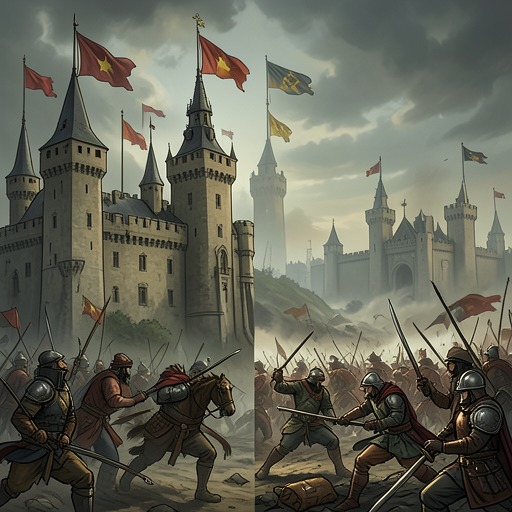
The War of Five Crowns
This thread traces the fragmentation of the realm as rival kings turn a succession crisis into a continental war.
The Fall of Winterfell
This thread traces how Theon Greyjoy captures, loses, and symbolically destroys the Stark stronghold.
Daenerys's Dragon Renaissance
This thread follows Daenerys Targaryen from the birth of her dragons to the first political opportunities created by their return.
